The Cook County, Illinois, Coyote Project


  Where Urban  Coyotes Are Found


Where Are Urban Coyotes Found?


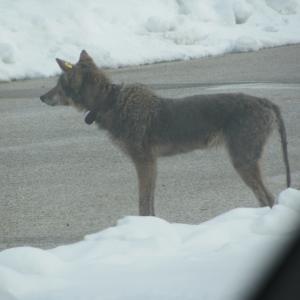
Radio-tracking revealed two different types of movement patterns among coyotes, and these differences were related to social behavior. Members of packs had small territories averaging three square miles (8 km2), whereas solitary coyotes ranged over much larger areas and had home ranges averaging 25 square miles (62 km2).

See yellow lines below on map for movement of this coyote

Home ranges are areas used by animals to meet their daily needs and may overlap with home ranges of neighbors; territories are also home ranges except that they are defended from other individuals and do not overlap. In the case of coyotes, groups (or packs) defend their territories from other groups, whereas solitary coyotes do not defend their home ranges. Other studies have also found that territory sizes of coyotes decrease with increased urbanization given adequate food is available. In general, studies have found that urban coyotes tend to have smaller territories than rural coyotes.


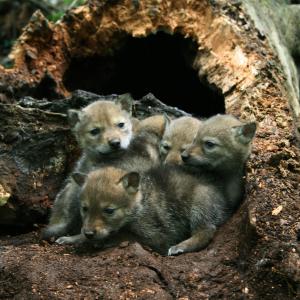
Litter from 2006 - Several individuals were radiocollared later that year and now radiotracked along with the parents.

Many coyote territories are associated with large parks or forest preserves, which provide an abundance of cover and food. In these cases, the boundaries of territories will often follow the park boundaries. However, much to our surprise, other coyotes have been able to establish territories and form
packs without the benefit of large blocks of habitats. This formation of packs
and territories can even occur in downtown areas, if parks or natural areas exist
in scattered, small patches. In some cases, these are coyotes that have
created territories in residential areas or complexes of small parks and golf courses.
In either case, coyotes manage to defend these territories so that the territories have very little overlap, which controls their density and spatial arrangement across the landscape. This is frequently called a land-tenure system. We still have much to learn about how coyotes maintain packs in downtown areas. See more here. . .


Approximately 50 percent of the coyotes radio-collared as subadults (one to two years of age) or adults have been solitary for at least a portion of the study. The home ranges of solitary coyotes span large areas of the metropolitan area, and they overlap extensively with pack territories as well as other solitary coyotes. Solitary coyotes use a wide variety of habitats and can be found in virtually any
part of the metropolitan area, even in downtown areas. We have observed some
solitary coyotes finding mates and establishing their own territories, whereas
others eventually disperse and leave the area permanently. In a few cases, resident
adult coyotes have left their territories after the death of a mate. Moreover, we have
observed individuals change from solitary coyotes with large movement patterns to
members of social groups with small territories (and vice versa).
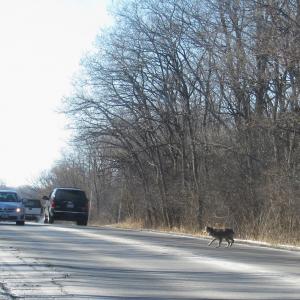
Given the large areas traversed by coyotes and the number of roads coyotes
regularly cross during their activities, it is not surprising that vehicles are the most
common cause of death. Some of the roads crossed by coyotes in our study have
average traffic volumes of more than 100,000 vehicles every 24 hours.

Distribution of coyote packs during 2004. The area of the map encompasses at
least 12 cities over 260 square miles. Each color represents the home range of an alpha male
or female that represents the territorial boundary for the pack. Some territories are fragmented as a result of the computer model used to estimate the boundaries, but it is obvious that territories
have only limited overlap.

Distribution of coyote home ranges during 2004. Light green lines represent the
home ranges of solitary coyotes, while the smaller colored areas represent
the territorial boundaries of packs (as seen in the previous figure). O’Hare
International Airport is located in the lower right corner. The large home
ranges of solitary coyotes overlap territories of packs as well as home
ranges of other solitary individuals.


The Cook County, Illinois, Coyote Project


The Ohio State University